
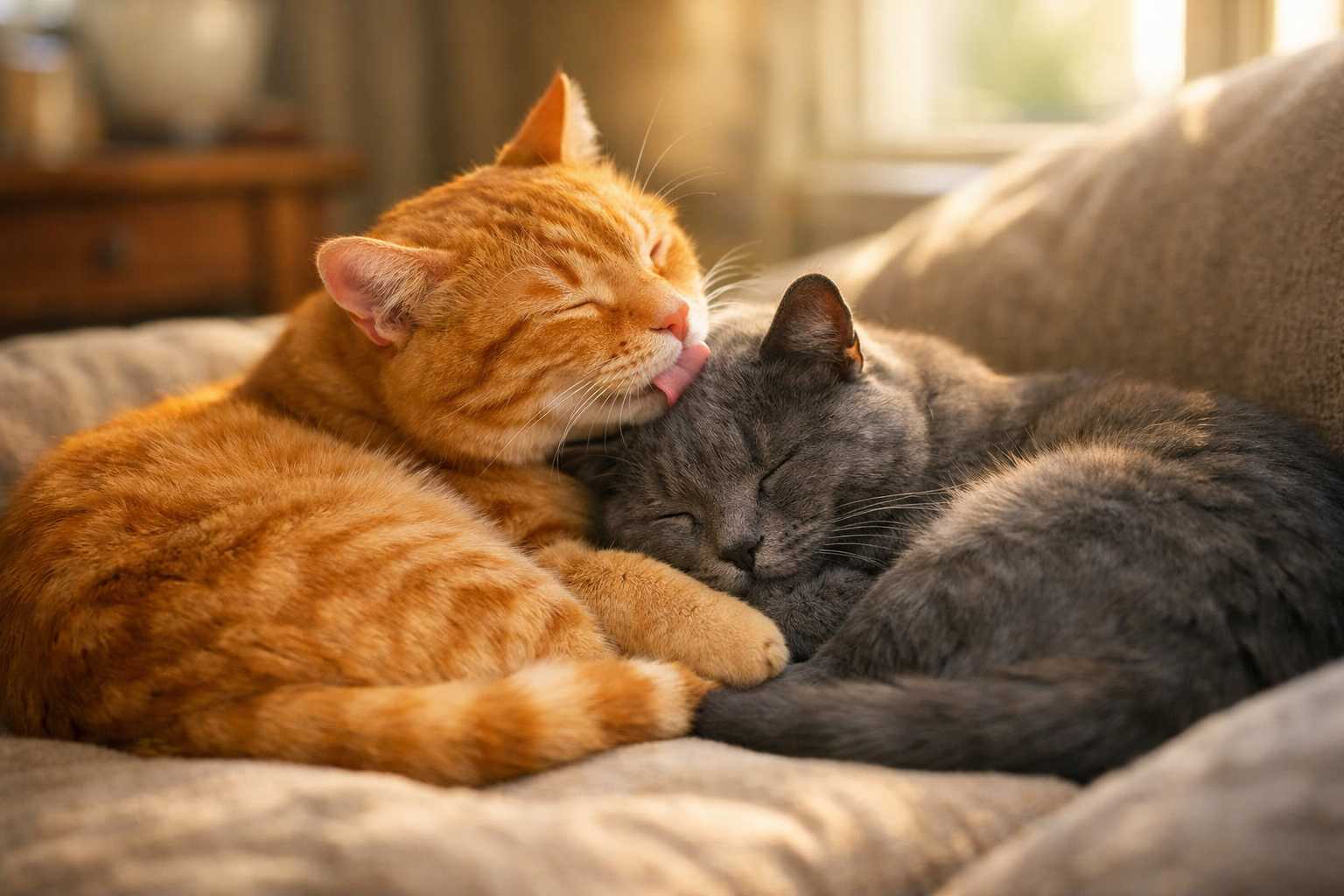
Have you ever seen two cats curled up together and wondered whether they’re truly bonded, or simply getting along?
It’s a common question, and an important one. Understanding the relationship between your cats can help you make better decisions about their daily care, living environment, and overall well-being.
Here are 10 reliable signs that two cats may share a genuine bond.
What Does It Mean for Cats to Be Bonded?
A bonded pair is more than just two cats that peacefully coexist. Some cats may tolerate each other, share space without conflict, or ignore one another most of the time. Bonded cats, however, usually show a deeper social connection.
They actively seek each other out, appear relaxed in one another’s presence, and may rely on each other for comfort and security.
You can think of it as a close friendship—just expressed in cat behavior.
Some cats bond quickly, especially littermates or cats raised together. Others may take months to build trust. And some cats never become truly bonded, even if they live together successfully.
Why It Matters
Recognizing a bonded relationship matters more than many people realize.
If one cat needs to be rehomed, hospitalized, or kept apart for medical reasons, separation can be stressful for both cats. In strongly bonded pairs, that stress may show up as vocalizing, hiding, changes in appetite, clinginess, or other behavior changes.
On the other hand, if your cats are bonded, that companionship can be a real source of enrichment and emotional stability in their daily lives.
That said, it’s worth noting that not every affectionate pair is equally dependent on one another. Bonding exists on a spectrum.
1. They Sleep Close Together
Sleeping near another animal requires trust. Cats are most vulnerable when resting, so they tend to choose sleeping companions carefully.
If your cats regularly nap pressed against each other, curled together, or in repeated close contact, that’s a strong sign they feel safe and comfortable together.
Occasional proximity alone doesn’t prove a deep bond, especially in cold weather or in a favorite sleeping spot. But if they consistently choose to sleep together when other options are available, that means something.
2. They Groom Each Other
Mutual grooming, known as allogrooming, is one of the clearest signs of feline social bonding.
When cats groom each other—especially around the head, face, and neck—they’re doing more than helping with hygiene. They’re reinforcing trust, familiarity, and social connection.
Not all friendly cats groom each other often, but regular, relaxed grooming is a very positive sign. If one cat always grooms while the other never reciprocates, that can still be normal, as long as both cats seem comfortable.
3. They Play Gently and Take Turns
Play between bonded or friendly cats usually looks loose, balanced, and voluntary.
You may see chasing, pouncing, wrestling, and mock ambushes—but without signs of real fear or escalating tension. Their bodies tend to stay relaxed, and the interaction has a back-and-forth rhythm rather than one cat relentlessly pursuing the other.
Healthy play usually includes:
– pauses or breaks
– role switching
– little or no vocal conflict
– no one hiding or trying to escape repeatedly
A bit of intensity can still be normal, but if play often ends in hissing, swatting, or avoidance, it may be less about bonding and more about tension or mismatched play styles.
4. They Rub Against Each Other
When cats rub their faces or bodies against each other, they’re sharing scent through glands located around the face, cheeks, and head.
This behavior, often called bunting, is a social gesture that helps create a shared group scent. In simple terms, it’s a feline way of saying, “You’re one of mine.”
If your cats often greet each other with head rubs or body rubs, that’s a strong sign of familiarity and affection.
5. They Greet Each Other Calmly, Sometimes Nose to Nose
A nose-to-nose greeting can be a meaningful sign of trust, especially if it happens naturally and repeatedly.
Cats often use these brief greetings to check in with one another. It’s usually a quiet, gentle interaction rather than a dramatic one.
Not every bonded pair will do this often, but if your cats regularly greet each other with nose touches, soft body language, or friendly face rubbing after time apart, that points to a positive relationship.
6. They Choose to Be Near Each Other
One of the clearest indicators of a bond is voluntary proximity.
If your cats consistently choose the same room, the same couch, or neighboring resting spots—even when the house offers plenty of space—they likely enjoy each other’s company.
Sometimes one cat may quietly follow the other from room to room. In other cases, they simply seem to prefer being nearby without necessarily interacting much.
This kind of repeated closeness often says more than dramatic gestures do.
7. They’re Comfortable Around Food and Water
Food can bring out tension in some cats, especially in multi-cat homes. So if two cats can eat near each other without signs of guarding, staring, blocking, or swatting, that suggests a high level of comfort.
However, this sign should be interpreted carefully. Some bonded cats still prefer separate bowls or a little personal space at mealtimes, which is perfectly normal.
What matters most is whether they remain relaxed around shared resources, not whether they literally eat shoulder to shoulder.
8. They Notice and React When Separated
If one cat goes to the vet or is temporarily isolated, the other may clearly notice.
A bonded cat may search the house, sit by the door, vocalize more, seem restless, or act unusually quiet. In stronger bonds, appetite or routine may temporarily change.
That said, separation-related behavior isn’t always proof of a deep bond. Cats can also react to disruption in routine, unfamiliar smells, or household changes. But when separation distress appears alongside several other bonding signs, it becomes more meaningful.
9. They Use Soft Social Signals With Each Other
Cats communicate with one another in subtle ways.
Bonded or socially comfortable cats may exchange slow blinks, trills, chirps, gentle tail movements, or relaxed eye contact. They may orient their ears toward each other, respond calmly to one another’s movements, and appear socially “in sync.”
It’s true that adult cats usually meow more at humans than at other cats, so frequent meowing between cats is not a major bonding sign on its own. But soft trills and relaxed body language can be good clues that they feel connected and at ease.
10. They Seek Each Other Out During Stress
One of the strongest signs of a close bond is social comfort during stressful moments.
If one cat is startled by thunder, unfamiliar visitors, or a change in the home, does the other move closer? Do they sit together, groom each other, or settle side by side afterward?
Some bonded cats act as emotional anchors for one another. They may not “comfort” each other in a human-like way, but their presence can clearly help the other cat feel safer and calmer.
What If Your Cats Don’t Show All 10 Signs?
That’s completely normal.
Not every bonded pair will display every sign on this list. Some cats are affectionate and expressive. Others are more reserved, even when the bond is strong.
The most helpful approach is to look for consistent patterns over time, not isolated moments.
For example, two cats that regularly sleep together, groom each other, and seek each other out may be strongly bonded—even if they never eat side by side or show obvious separation distress.
Can You Help Two Cats Bond?
Sometimes, yes—but it’s important to be realistic.
You can encourage a positive relationship, but you can’t force a true bond. Some cats become close companions, while others simply learn to coexist peacefully. Both outcomes can be successful.
To support a healthy relationship:
- Introduce cats gradually. Slow introductions reduce stress and help prevent fear-based conflict.
- Use scent exchange. Swap bedding or soft cloths so each cat becomes familiar with the other’s scent before direct contact.
- Create positive associations. Offer treats, play sessions, or meals at a comfortable distance so they link each other’s presence with good experiences.
- Provide enough resources. Make sure there are multiple litter boxes, feeding stations, resting areas, scratching posts, and hiding spots.
- Avoid forcing interaction. Let them choose when and how to engage.
Patience matters. A calm setup and a sense of control can make a big difference.
Final Thoughts
Seeing two cats form a real bond is one of the most rewarding parts of sharing your home with them.
In most cases, a bonded pair will show a combination of signs: resting together, grooming, choosing close proximity, greeting warmly, and remaining relaxed around each other. No single behavior proves a bond by itself, but repeated patterns usually tell the story.
If you think your cats may be bonded, it’s worth protecting that relationship whenever possible—especially when making decisions about travel, veterinary care, foster placement, or rehoming.
And if your cats are still getting to know each other, don’t lose heart. Some feline relationships grow slowly and quietly.
Often, the strongest bonds are the ones that develop with time. 🐾
SEO Details
Best SEO Slug:
how-to-tell-if-two-cats-are-bonded
Focus Keyphrase:
how to tell if two cats are bonded
Meta Description:
Wondering whether your cats are truly bonded? Learn 10 common signs of a close feline bond, from mutual grooming and sleeping together to calm greetings, proximity, and separation-related behavior.