
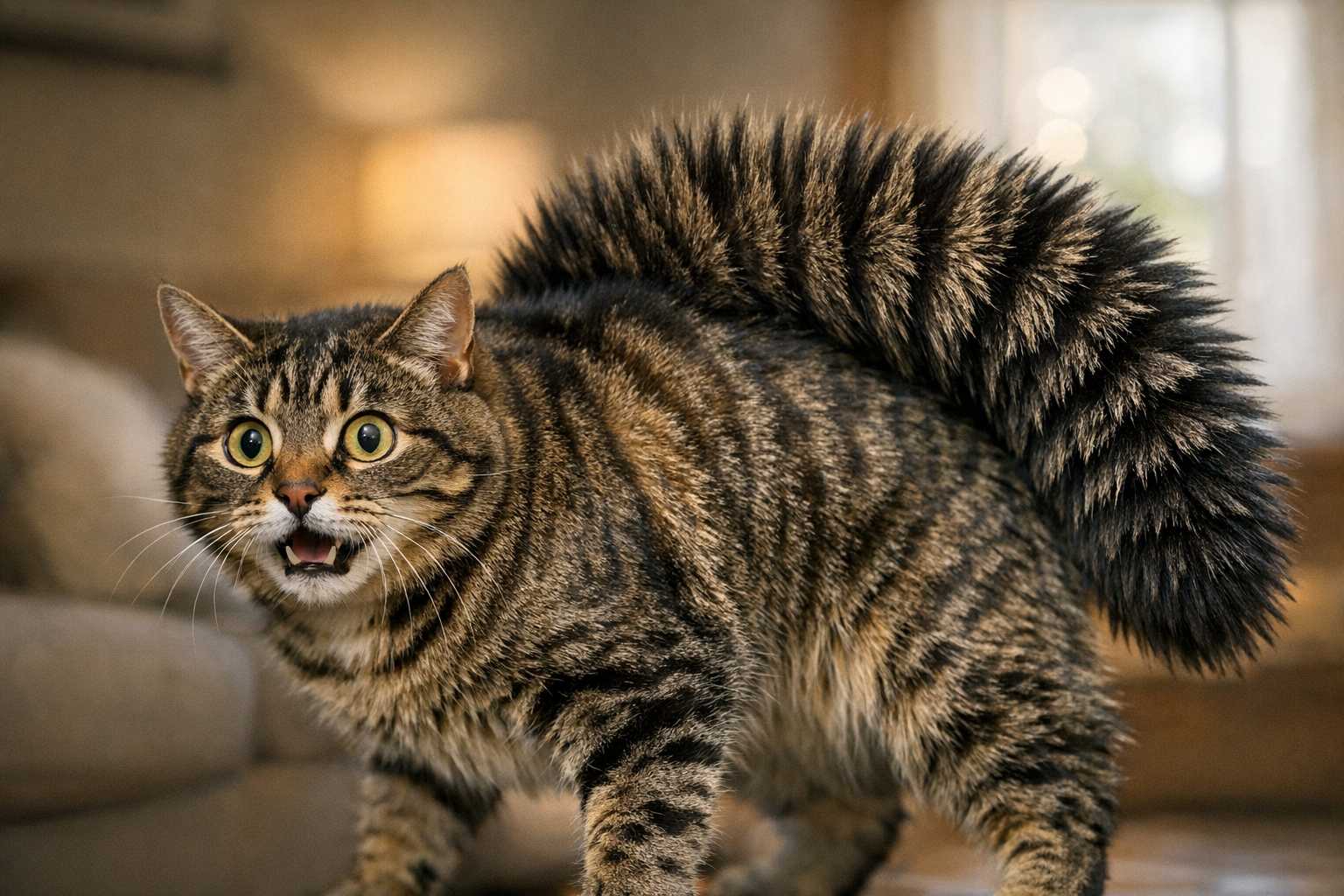
Have you ever seen your cat walking through the room as if nothing is wrong, only for their tail to suddenly puff up into a giant bottle brush?
It is one of the most striking behaviors cats display, and it can happen in an instant.
So what does it mean? Is your cat frightened, annoyed, excited, or simply startled?
In most cases, cat tail puffing is a normal body-language signal. To understand it correctly, you need to look at the situation and the rest of your cat’s posture.
What Is Cat Tail Puffing?
Cat tail puffing happens when the fur on a cat’s tail stands on end, making the tail look much larger than usual. In some cases, the fur along the back may rise as well.
The scientific term for this reaction is piloerection. It is an automatic response controlled by the nervous system, not something your cat does on purpose. A simple human comparison would be goosebumps, although in cats the effect is much more visible.
This response usually appears when a cat is emotionally aroused, especially by fear, stress, excitement, or sudden surprise.
Why Do Cats Puff Their Tails?
There is no single explanation for cat tail puffing. Cats may fluff their tails for several different reasons, and the meaning depends on the context.
1. Your Cat Is Frightened
Fear is one of the most common reasons a cat’s tail puffs up.
When a cat feels scared, the body shifts into a defensive state. The tail may become fluffy within seconds, and you may also notice an arched back, raised fur along the spine, wide eyes, or a tense posture.
Common triggers include:
- Loud or sudden noises
- Unfamiliar people
- Strange animals
- Quick movements
- Thunderstorms or fireworks
- Unexpected changes in the environment
If your cat’s tail puffs up because of fear, the best response is usually to give them space and allow them to calm down at their own pace.
2. Your Cat Feels Threatened
A cat that feels threatened may puff its tail to appear larger and more intimidating.
This is a defensive survival behavior. By making themselves look bigger, cats may discourage a perceived threat from getting closer. In these moments, a cat is not always trying to flee. Sometimes they are preparing to stand their ground.
You may also see:
- An arched back
- A sideways stance
- Hissing or growling
- Intense staring
- Raised fur on other parts of the body
This combination of signals means your cat is trying to warn whatever is bothering them to back off.
3. Your Cat Is Angry or Overstimulated
Cats sometimes puff their tails when they are irritated, frustrated, or overstimulated.
For example, this can happen if petting goes on too long, if another pet invades their space, or if something in the environment is causing tension. In this situation, the puffed tail is often part of a broader “leave me alone” message.
Other signs of agitation may include:
- Flattened ears
- Dilated pupils
- Tail swishing or thumping
- Tense muscles
- Low growling or vocalizing
If you notice these signs together, it is best to stop interacting and give your cat room to settle.
4. Your Cat Is Playing
Not all tail puffing is negative. In kittens and playful adult cats, a puffed tail can simply mean excitement.
Many cat owners have seen the classic playful “sideways hop” or “crab walk” with a fluffed tail. During play, cats often become highly stimulated, and that excitement can trigger piloerection.
Play-related tail puffing may come with:
- Jumping and bouncing
- Sideways movement
- Pouncing
- Chasing toys
- Bright, alert eyes
In this context, the behavior is usually brief and accompanied by loose, energetic movement rather than defensive tension.
5. Your Cat Was Startled
Sometimes a cat’s tail puffs up because they were simply surprised.
A loud sneeze, a dropped object, a sudden movement, or an unexpected sound can trigger an instant reaction. This kind of puffing is often short-lived. Your cat may freeze for a moment, look around, and then relax once they realize there is no real danger.
If the tail quickly returns to normal and your cat resumes regular behavior, a brief startle response is usually nothing to worry about.
6. Your Cat Is Experiencing Redirected Aggression
In some cases, a cat puffs their tail because they are intensely frustrated by something they cannot reach.
For example, a cat may spot another animal outside the window and become highly aroused. Because they cannot access the source of that excitement or frustration, they may redirect those feelings toward a nearby person or pet.
This is known as redirected aggression, and it can be serious.
If you suspect this is happening:
- Do not try to pick up or comfort your cat
- Avoid direct interaction
- Keep other pets away
- Give your cat time to calm down in a quiet area
Depending on the cat and the situation, this may take minutes or even longer.
How to Read the Full Picture
A puffed tail by itself does not always tell the whole story. The rest of your cat’s body language matters just as much.
Here is a simple guide:
| Body signal | Possible meaning |
|—|—|
| Puffed tail + arched back | Fear, defensiveness, or aggression |
| Puffed tail + playful hopping | Excitement during play |
| Puffed tail + flattened ears | Feeling threatened or overwhelmed |
| Puffed tail + frozen posture + wide eyes | Startled or alarmed |
| Puffed tail + growling or hissing | Strong warning; give space |
Context is key. A cat playing with a toy may look very different from a cat confronting another animal, even if both have puffed tails.
Should You Be Worried?
Usually, no. Cat tail puffing is a normal and healthy form of communication.
However, it is worth paying closer attention if:
- It happens often without a clear trigger
- Your cat seems chronically anxious or tense
- It regularly leads to aggression
- Your cat is showing other signs of illness or distress
- There have been major changes in the home and your cat seems unable to adjust
In these situations, a veterinary visit is a good idea. A vet can help rule out pain, medical problems, or chronic stress that may be contributing to the behavior.
How to Help a Cat With a Puffed Tail
If your cat’s tail is puffed because they are scared or agitated, a calm response is best.
Stay calm
Cats are very sensitive to tone, movement, and energy. If you react dramatically, your cat may become more stressed.
Give them space
Do not rush in to pet, hold, or reassure your cat physically. Many cats prefer distance when they are frightened or overwhelmed.
Remove the trigger if possible
If another animal outside is causing stress, close the blinds. If the room is noisy, reduce the sound. If your cat needs to retreat, provide a quiet, safe space.
Speak softly
A gentle voice can help, as long as you are not forcing interaction.
Never punish the behavior
Tail puffing is an involuntary response. Punishment will not fix the problem and may make your cat more fearful.
A Few Interesting Facts About Cat Tail Puffing
- Kittens often puff their tails more during play because they are still developing confidence and coordination.
- Some cats are naturally more reactive than others.
- “Bottle brush tail” is a common nickname for this behavior.
- In intense situations, cats may puff the fur on their tail, back, and entire body.
- Big cats can show similar fur-raising behaviors, which reflects the deep evolutionary roots of this response.
The Bottom Line
Cat tail puffing is a clear sign that your cat is feeling a strong emotion. That emotion might be fear, defensiveness, irritation, excitement, or simple surprise.
The key is not to focus on the tail alone. Look at your cat’s posture, facial expression, surroundings, and recent triggers to understand what they are trying to communicate.
The more familiar you become with your cat’s body language, the easier it will be to recognize what they need in the moment, whether that is space, reassurance, or a chance to keep playing.