
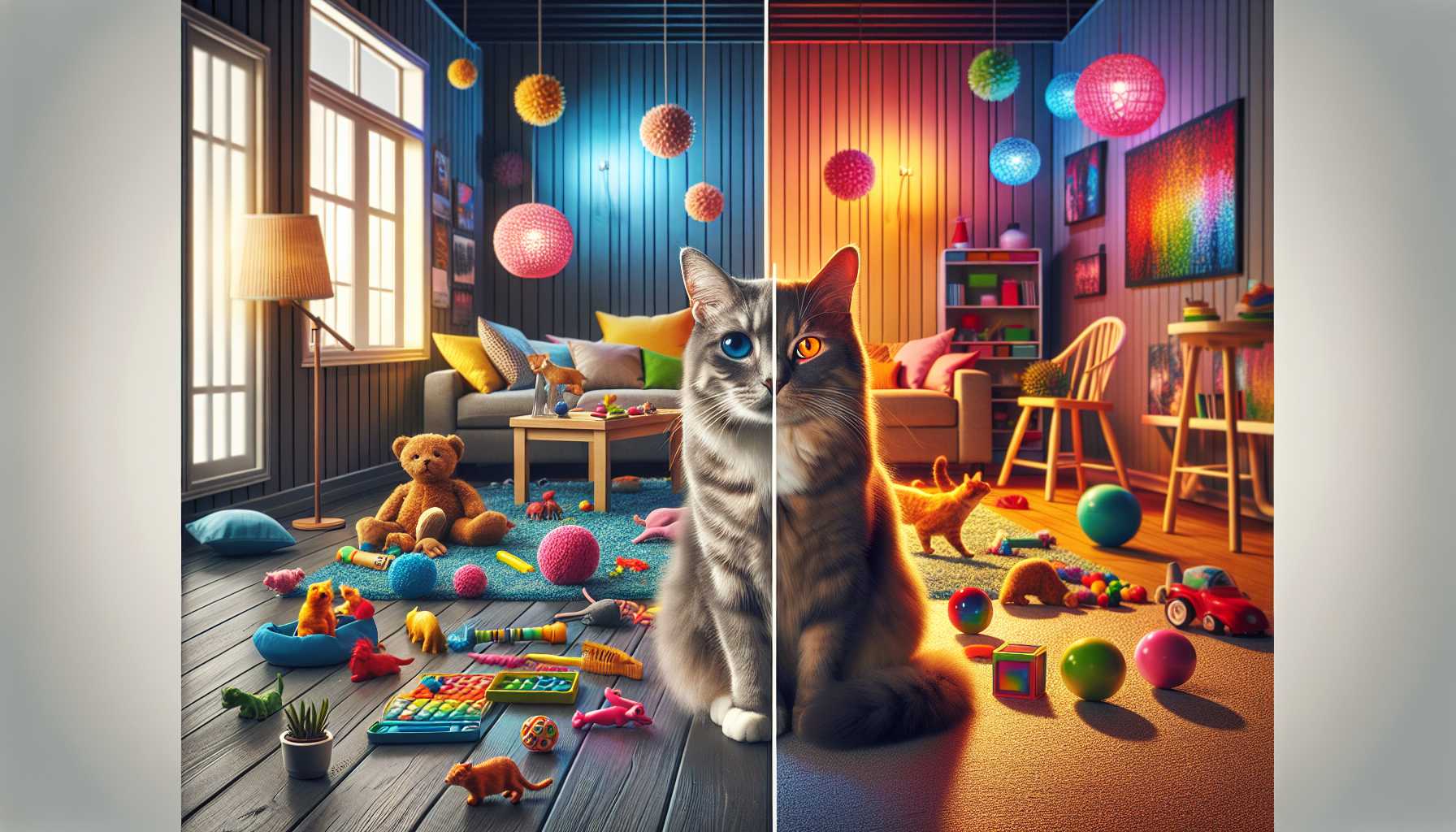
Have you ever noticed your fluffy companion is uninterested in a bright red toy? Let’s delve into the fascinating reality around the way cats visualize and understand colors.
Cats and Their Unique Color Vision
Compared to humans, cats don’t see colors to the same extent. While they aren’t fully color blind, they view the world differently than we do. Cats mainly discern blues and greens, with reds and pinks seeming more gray-toned to them.
The Biology Behind a Cat’s Vision
There’s a unique element in the eyes of our feline friends known as rod cells. These cells allow them to see better in low lighting, making them efficient predators in the dark. However, the number of cone cells – responsible for color perception – is lower in cats than in humans.
Debunking Misconceptions
Contrary to popular belief, cats certainly are not fully color blind! They merely perceive colors in a way that deviates from our own vision. Imagine viewing the world through an old, faded color television set – that’s how cats see their surroundings.
How Cat Vision Influences Their Daily Activities
The way cats see colors is indeed well-aligned with their living requirements. For instance, they:
– Have a knack for detecting movement
– Can see efficiently in dimly lit conditions
– Are able to keenly focus on their survival needs
Improving Your Cat’s Home Environment
Wish to make your home more accessible for your cat? Follow these guidelines:
– Use toys in shades of blue and green for enhanced interactions
– Implement color contrast in their surroundings
– Ensure ample lighting in their preferred locations, and
– Install nightlights in darker spaces
Understanding Your Cat’s Behavior Relating to Colors
Have you seen your cat ignoring that bright red laser dot until it begins to move? That’s because motion is much more crucial to them than color. Thus, they are responding to the movement of the dot rather than the color itself.
Identifying Vision-Related Issues in Your Cat
While limited color perception is normal for cats, these worrying signs may indicate vision-related problems:
– Accidentally bumping into furniture
– Hesitating to jump
– Unusual discharge from their eyes
– Alterations in pupil size
Helping Your Color-Limited Feline Friend
Bear in mind, your cat’s vision is perfectly tailored to their needs. The color limitations in their vision are balanced out by:
– Superior night vision
– Exceptional motion detecting capabilities
– Wide peripheral vision
– Remarkable focus at close range
Future Directions in Feline Vision Research
Researchers are persistently working to expand our understanding of cat vision. They are exploring:
– Methods of processing visual information in cats
– Strategies for creating cat-friendly environments
– Possible techniques to enhance cats’ vision
In conclusion
Your cat’s color perception might not match your own, but that doesn’t mean they’re any less capable. Their unique vision is perfectly adapted to their lifestyle, helping them thrive in every situation.